Coding is fun!
Yes, I really enjoy it! But the source of this enjoyment isn’t the typing, it’s the process of creating something new, then sharing it with the world or with friends. I’ve made games, open-source plugins for WordPress, and even a website for a friend’s birthday, among other projects created just for funsies.
And since I’ve been dabbling in tech and/or coding professionally for almsot 30 years now (Oh crap! I think I’m old!) I’m lucky enough to be able to code software from scratch, instead of using pre-made solutions.
Building a chat system from scratch
When we first launched Society of Curiosities in 2020, one of our innovations was a custom-built chat system that allows you, the researcher, to talk to a character from the game: your “team on the ground”.
These characters needed to sound realistic enough to provide some suspension of disbelief, but they are also in effect, a mechanism for you, the player, to submit solutions to the puzzles in our games. So using a pre-made chatbot system was out of the question; puzzles require very specific answers and, in turn, provide very specific instructions or feedback for the next puzzle.
So I built a chatbot based on lexical fields, with the assumption that any answer to a puzzle can be given in a finite number of ways, even when using natural language. It can be several hundreds of ways, but it is finite. Players who attempt to find the limits of the chatbot will hit these limits very quickly (it’s not designed to be a typical chatbot), but players who attempt to provide answers to the puzzles in front of them will, hopefully, get the feeling they are chatting with a real person. We also added a random delay before the bots reply to add to the illusion!
All of this was (and still is!) a ridiculous amount of work. So, as a solo developer, I chose to develop the chat with with a framework called Meteor, a website-building system that does a lot technical tasks automagically behind the scenes. Unfortunately, all this behind-the-scenes magic was deemed vulnerable to hackers and over the years, Meteor became less magical (but safer).
Modernizing the Society of Curiosities codebase
Starting in 2023, I started experimenting with ways to keep all the things I loved about Meteor’s early versions.
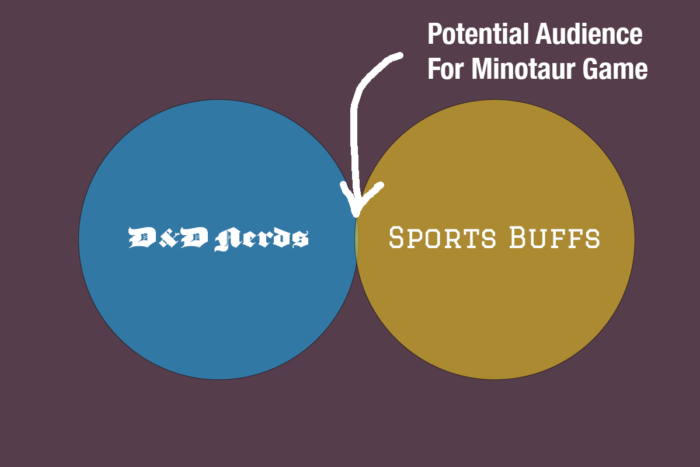
I needed a throwavay project to make these experiments, so I made a game: an idle game of minotaur fantasy football – strange, I know. But, who knows, there might be a tiny sliver of overlap in the D&D nerd / sports buff Venn diagram!
I tried cloning parts of the Meteor codebase (it’s open-source) to modify it, but that was way too much work. I tried other Frameworks and tools (for those interested: laravel, ionic, react (yuck!), plain PHP, plain JS) but nothing quite worked.
Alongside all of this, over the past 2 years, I stayed abreast of ai-coding tools. At first, when these tools started popping up in code-editing software, I turned them off completely. They just broke things. A few months later, I tried the code-writing ai products like Claude and Copilot (and I believe I canceled my subscription with feedback: ‘I can write terrible code myself, thank you very much!’).
Then, some time in 2026, these tools became good at coding. Not just useful to auto-complete code, but genuinely good (with a few caveats, of course). With a well-defined task and lots of existing context (let’s say a half-finished minotaur game!) these coding agents can do in minutes what I could only do in days, or even weeks!
Is this fun?
Now, back to puzzle design and game design.
Even though our technical workload may have changed and the limits of what’s possible for a small team have changed, we have to keep in mind:
- Computers are stupid
- They have no taste
- They have no judgment
- They don’t know what’s fun or tedious
- And, my favorite, if you’re not careful the your AI helper could delete your beloved computer files!
Over the last few months, as I was toying with the capabilities of these coding agents and making this minotaur game (and completely breaking said games many times), I realized something:
The most time-consuming and important part of our job as game designers is *still* design and playtesting
Ultimately, the technical implementation of a creative idea remains a minor task because it can always be adapted to the skills and resources of the design team. In fact, constraints often promote creativity and originality! Some of the most enjoyable puzzle games I’ve played recently were low-tech (Saving Atlantis from Shannon McDowell) or no-tech (The Pirate Code Puzzle Card from Mystery Unfolds, Lost In The Shuffle from Spencer is Puzzling).
The questions we need to ask ourselves remain the same. Mostly Is this fun? and Will this be memorable? Now, it seems we have entered an age in which our technical tasks will require less tedium, but the creative work remains the same.
So here it is, for your enjoyment (if you’re in the Venn diagram overlap): Minos Pro – an idle game in which minotaurs compete in medieval football through mazes! It’s an idle game, so you can set up your team and strategy and check in on them every few days (or every few hours, or every few minutes!).
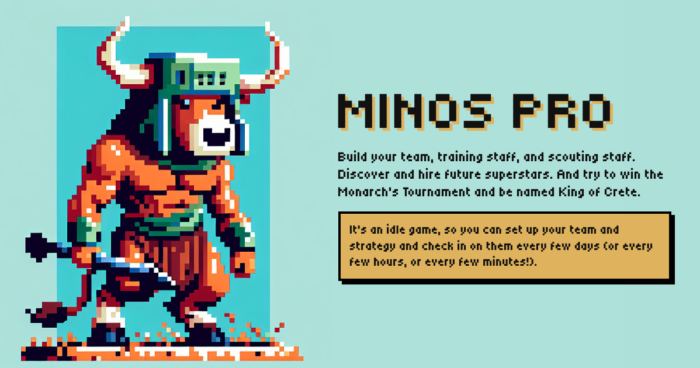
Play here: https://play.minospro.com
Have fun!